Written by: Mümin İNAN | Creative Director, MAC ART
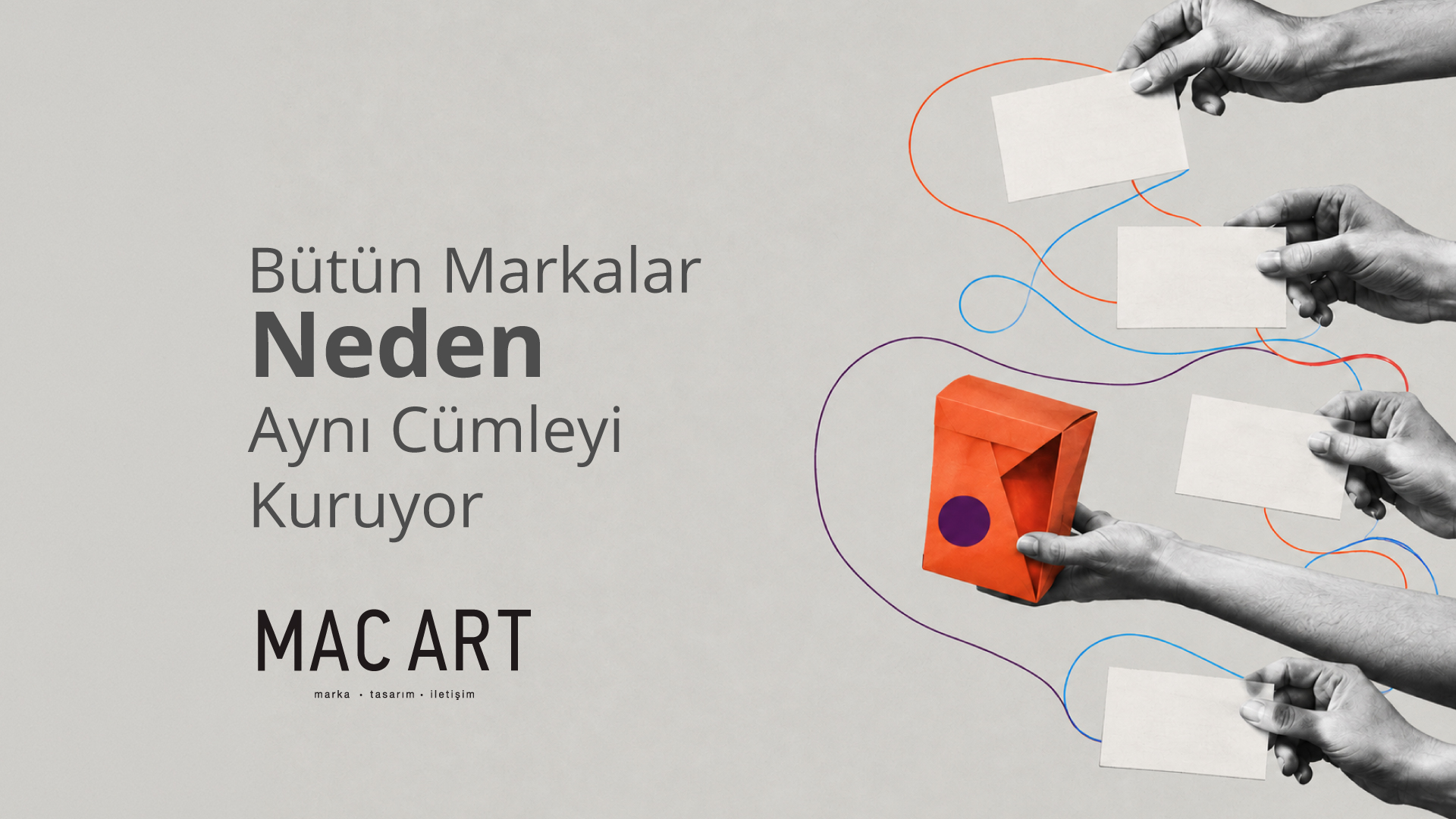
Imagine a simple experiment. We print the homepages of five different companies and lay them on a table. We cover the logos, company names and product photos. All that remains are the sentences the companies chose to describe themselves.
“We deliver innovative solutions.” “We make a difference with our customer-focused approach.” “We add value to the future without compromising on quality.” “Your reliable solution partner.” “We develop solutions tailored to your needs.”
Then we ask the people around the table which sentence belongs to which company. Most likely, no one can answer correctly. One of these sentences could belong to a software company, another to a logistics firm, another to a manufacturer, a consultancy or an advertising agency. Their names and what they do are different. The moment they start describing themselves, they all become the same person.
A short search online shows that phrases such as “innovative solutions”, “customer-focused approach”, “without compromising on quality” and “reliable solution partner” are repeated across distant sectors such as technology, consulting, certification, logistics and retail. These words are not wrong. They are simply so general that almost anyone can say them. If a sentence fits every company, it describes none of them.
The language that makes companies look alike
No company wants to look ordinary. Yet a strange gravitational pull appears when corporate copy is being written. Management wants the company to look reliable, high-quality, innovative and customer-focused. The person writing the text avoids risk and reaches for the words that already feel corporate. The result is a text that is hard to object to — and just as hard to remember.
Who inside a company can argue with “We are customer-focused”? “We never compromise on quality” is equally safe. Since no one will announce that they produce poor quality, the sentence sails through the meeting. This is the first reason corporate texts look alike: the easiest sentences to approve are often the ones that carry the least meaning.
What is truly different about a company is usually rough around the edges. It may need to say it is not right for every client. It may admit that it does not do certain kinds of work. It may explain why its price is not cheap. If it has a different approach to production, design or service, it accepts that not everyone will like it. Generic sentences remove that risk. They make the company too perfect to challenge, and too colourless to be curious about.
If every brand wants to be different, why do they use the same words?
Because shared words make internal approval easier. A different view requires evidence, preference and responsibility. Safe words end the discussion in the short term; in the long term they make the brand invisible.
Quality sentences that do not describe quality
Imagine a restaurant with a sign that says “our food is delicious”. That sentence tells you almost nothing about the restaurant. No restaurant announces that its food is tasteless. When the same restaurant says “our dumplings are folded by hand in the kitchen every morning”, a picture forms in the mind. Instead of “we use quality ingredients”, “we buy our olive oil from the same producer in Milas at every harvest” turns quality from an abstract claim into a visible detail.
It is no different for companies. “We deliver our projects on time” is a generic promise. “We share the work schedule before the project starts, and we inform the client before they have to ask when a delay risk appears” describes a way of working. “We offer tailored solutions” can be used by hundreds of companies. “We do not sell ready-made packages; we define the scope together according to need, budget and priorities” is more concrete. The reader may like this approach or not — but they understand what is being said.
Concrete language is not superior in every situation. Research shows that the effect of abstract and concrete language can change with context. Abstract language can sometimes create a sense of vision or a big idea, while concrete language can strengthen the feeling of attention, competence and that a real problem has been understood. The point is not to delete every abstract word, but to support abstract claims with behaviour people can see.
“We are reliable” is an abstract claim. Being reachable over many years, showing real client references, naming project owners and describing what happens when a problem appears are parts of trust. “We are innovative” is an abstract claim. Showing which different method you used to solve a problem a client had not been able to solve for years is evidence of innovation. “We are experienced” is an adjective. Describing which sectors and which kinds of problems you work with is the experience itself.
Why does saying “we are high quality” not describe quality?
Because the word quality on its own carries no measure, behaviour or proof. The reader wants to see quality in the process, in material choices, in the way of delivery, in examples and in results.
Proof instead of adjectives
Writing an adjective is easy; finding proof is hard. Writing “a leader in its field” takes a few seconds. Explaining which product, method, patent, practice or result that leadership is built on requires looking inside the company. Writing “sustainable production” is easy. Documenting energy use, material choices, waste volumes or a change in the supply chain takes work.
That is why many companies’ communication problem is not only a writing problem. The company has not yet gathered the evidence about itself. The person preparing the website then fills the gap with the safe words everyone already knows.
In the MAC ART approach, brand language is not the job of finding nice words for a company. It is the job of turning the company’s real way of working into language. A copywriter cannot invent a difference that does not exist with words alone. They can, however, discover something the company has been doing for years and now treats as ordinary. Not adding unnecessary items to a proposal, visiting the site before design begins, or making sure the client can reach a single contact when a problem appears can show the company’s real behaviour. The company may see this as simply the work that needs to be done. For the client, it may be exactly the reason to choose them.
The moment the customer chooses
When people cannot tell the options apart, they do not stop deciding. They turn to other criteria. They look at price, pick a familiar name, accept a friend’s recommendation, or go to the brand that appears more often in search. Lookalike brand language is therefore not only a communication problem. It is a commercial problem that pushes the company toward price comparison. In how to choose an advertising agency, customers often meet the same generic sentences.
Being distinctive does not only mean having a different logo. Ehrenberg-Bass Institute work on brand assets stresses that a strong distinctive asset should be widely recognised and should predominantly call one brand to mind. A colour, shape or phrase that also recalls other brands struggles to own a place in memory.
The same idea applies to brand language. “High-quality and innovative solutions” could belong to any company. An original phrase used consistently over years and tied to a real way of working can become one of the brand’s signs. The critical word here is not only originality; consistency is also required. A company that finds a new slogan every year may look creative, but it cannot build a lasting mark in people’s minds.
Brand design and packaging design
Brand design and packaging design carry the visual side of the same problem. When every brand in a category uses the same colours, the same leaf icon, the same product-photo layout and the same “natural” signs, the design may look tidy — but it may not be distinctive. When packaging repeats competitors’ language on the shelf, the consumer may understand the product and still fail to remember the brand.
Good brand design does not only try to look different. It builds an ownable link between the brand’s name, colour, form, typography, visual rhythm and packaging structure. Good packaging design does more than decorate the product; it makes the category understandable, makes the product easier to find and repeats the brand’s signs in memory. The cliché in the text and the cliché in the visual lead to the same result: the brand looks correct, but it is not clear who it belongs to.
That is why brand language, corporate identity and packaging cannot be managed as separate files. The words the company says and the signs it gives on the shelf or on screen must build the same identity. This unity is also the core issue MAC ART addresses in brand design, corporate identity and packaging work.
Related MAC ART example: Inceoglun brand and packaging work
Corporate language and corporate cliché
Being corporate is not about writing long, distant sentences. “Our organisation develops innovative and sustainable solutions in order to keep customer satisfaction at the highest level” may look corporate, but it does not create a scene in the reader’s mind. “We see your production line before we quote” is shorter and more human. It also describes how the company works.
Instead of “We offer tailored solutions to every client”, you can say “We do not propose the same package to two different brands.” Instead of “We value strong communication”, you can say “You know from the start who you will speak to throughout the project.” These sentences are not less corporate. They are more meaningful because they show the company’s working system clearly.
Corporate language and bureaucratic language are not the same thing. Corporate language is the ability to express the same approach consistently across different touchpoints. Bureaucratic language is hiding responsibility and meaning behind words.
How AI tells brands apart
This question is no longer important only for people. People still research companies through Google results, social accounts and websites. ChatGPT, Gemini and similar answer systems have been added to that. A user no longer only searches “Denizli advertising agency”; they can also ask a detailed question such as “Suggest a Denizli-based agency with B2B experience that can run brand design and a web project together.”
For an answer engine to tell brands apart, it needs clear information. Where is the company, which fields does it work in, what is its approach, which claims can be verified by independent sources, and is there a consistent company definition across pages? The answers to these questions cannot be given with keywords alone.
Google states that a separate GEO schema is not required for AI search features. Core SEO conditions still apply: the page must be crawlable, important information must exist as text, it must be reachable through internal links, structured data must match visible content, and the content must help people.
This does not mean that companies using the same words will never appear in AI results. A stronger conclusion is this: the less original, concrete and consistent information a brand uses to define itself, the harder it becomes for both humans and machines to tell it apart from others. Writing for AI is not making the text robotic; it is reducing ambiguity.
How will AI tell lookalike brands apart?
It uses clear signals such as location, service, expertise, projects, author, references and independent citations. Pages that repeat the same generic adjectives offer less concrete information to support that distinction.
The line between odd and different
There is another trap brands fall into when they try to escape shared sentences: producing slogans that are hard to understand just to look different. The fact that a sentence resembles no one else does not mean it is good. If people cannot tell what the company does after reading it, the brand has not differentiated; it has hidden itself in fog.
Good brand language does two jobs at once. It explains which category the company belongs to, and why it is worth remembering inside that category. When an advertising agency defines itself only as “a creative universe that turns dreams into reality”, it may sound different; the visitor may not understand which services are offered. When it only says “we are an advertising agency”, it is clear, but ordinary.
The balance is combining category information with an original way of working. “A Denizli-based advertising agency that handles design, web and digital communication inside the same brand system” is not poetic. But it explains what the company is, where it is and how it works. Real projects and a working model can deepen that definition.
Do you have to be odd to be different?
No. A good brand sentence is first understandable, then different through a detail that belongs to the brand. Originality that cannot be understood does not make the customer’s decision easier.
Where real difference is found
Real difference is usually found not in the vision and mission document, but where the work is done. Why did a client come back a second time? Which job did the company refuse? What surprised the client? Which practice the industry treats as normal does the team consider wrong? How did the company behave when a problem appeared?
The answers to these questions do not contain perfect corporate sentences. They contain people, preferences, conflicts and real decisions. That is also where the story begins.
Google’s people-first content approach emphasises original information, first-hand experience, clear sources, identifiable authorship and offering new value instead of repeating existing content. Rewriting general information from other sites in different words is not enough. That is why telling a small but real observation from the company’s own experience is more valuable than writing “why brand awareness matters” for the hundredth time on a blog.
Customers not finding the product on the shelf after a packaging change, how ambiguity in a proposal turns into a question in a buying committee, or why a good-looking website lost trust — that is information belonging to that company. Anyone can reach information. The detail of experience is the hardest content to copy.
A sentence that belongs to the brand
Not every brand has to say the same sentence. To write a different one, they first need to stop trying to look different and look at how they actually work.
Brands sometimes think they need bigger words to describe themselves. What they often need is smaller, more concrete and more honest detail. Instead of quality, the decision that creates quality; instead of trust, the moment that tests trust; instead of experience, the behaviour that experience changed; instead of innovation, the thing done for the first time.
A brand’s language is not a decorated description of the company it wishes to be. It is the visible form of the choices it makes every day. If we cover the logos and cannot tell which company the sentences belong to, we are not facing only a copy problem. The brand may not yet have found the truth that would set it apart from others.
Perhaps the question is not “What more creative line can we write for our brand?” The real question is this: What can only we say about ourselves?
Sources
- Google Search Central — Creating helpful, reliable, people-first content
https://developers.google.com/search/docs/fundamentals/creating-helpful-content - Google Search Central — AI features and your website
https://developers.google.com/search/docs/appearance/ai-features - Ehrenberg Bass Institute — Brands of Distinction
https://marketingscience.info/news-and-insights/brands-of-distinction - Tourism Management — All words have consequences
https://www.sciencedirect.com/science/article/pii/S0261517724001511 - MAC ART — Why is corporate identity so important for a brand
https://macart.com.tr/en/blog/why-is-corporate-identity-so-important-for-a-brand.html - MAC ART — Inceoglun portfolio
https://macart.com.tr/en/portfolio/inceoglun.html - Web scan example — Jüpiter Bilişim
https://www.jupiterbil.com/ - Web scan example — Q1Cert quality policy
https://www.q1cert.com.tr/kurumsal/7-kalite-politikasi/ - Web scan example — Güneş Lojistik quality policy
https://www.guneslojistik.com.tr/PolicyDetail?Policy=9
